Solar System Simulator · Spacecraft · live
Where are the spacecraft right now?
Ten probes out among the planets and three craft circling Earth, each where it is today.
| Spacecraft | Signal time | |||
|---|---|---|---|---|
| Voyager 1 | 25.9 billion km173.2 AU | 25.8 billion km172.4 AU | 24.0 hourshr | 16.9 km/s60,914 km/h |
| Voyager 2 | 21.7 billion km145.1 AU | 21.6 billion km144.6 AU | 20.1 hourshr | 15.3 km/s54,945 km/h |
| New Horizons | 9.99 billion km66.8 AU | 9.89 billion km66.1 AU | 9.3 hourshr | 13.6 km/s48,868 km/h |
| Lucy | 925.7 million km6.19 AU | 782.8 million km5.23 AU | 51 minutesmin | 8.6 km/s31,101 km/h |
| Psyche | 233.9 million km1.56 AU | 283.8 million km1.90 AU | 13 minutesmin | 22.7 km/s81,878 km/h |
| BepiColombo | 160.4 million km1.07 AU | 53.1 million km0.35 AU | 8.9 minutesmin | 51.9 km/s186,759 km/h |
| Parker Solar Probe | 134.0 million km0.90 AU | 52.1 million km0.35 AU | 7.4 minutesmin | 53.0 km/s190,980 km/h |
| JUICE | 57.4 million km0.38 AU | 129.9 million km0.87 AU | 3.2 minutesmin | 38.7 km/s139,377 km/h |
| Europa Clipper | 10.0 million km0.07 AU | 138.9 million km0.93 AU | 33 secondssec | 36.8 km/s132,608 km/h |
| JWST | 1.69 million km0.01 AU | 149.3 million km1.00 AU | 6 secondssec | 0.1 km/srelative to Earth |
Worked out for Mon, Nov 23, 2026 (UTC) from JPL Horizons.
Out among the planets
Parker Solar Probe
Diving past the Sun every 88 days, 6 million km above its surface. Launched 12 August 2018 by NASA.
Parker Solar Probe is 134.0 million km (83.3 million mi) from Earth today, 0.90 AU, and 0.35 AU from the Sun. A radio signal takes 7.4 minutes each way, and it is moving at 53.0 km/s.
Parker Solar Probe flies closer to the Sun than anything before it. Its orbit, shaped by seven Venus flybys, takes it within 6.1 million km of the Sun's surface every 88 days, through the corona itself, at nearly 700,000 km/h at closest approach: the fastest any spacecraft has gone.
Its primary mission ended in 2025 after 24 passes through the corona; it keeps flying the same orbit on an extended mission, measuring the solar wind where it is born.
Parker weighed 685 kg at launch and still needed a Delta IV Heavy, because falling toward the Sun means cancelling most of the speed Earth gives a spacecraft for free. An 11.4 cm carbon-composite shield keeps the instruments behind it near room temperature, and the solar arrays are cooled with water and fold back into the shield's shadow on each close pass. It is named for Eugene Parker, who predicted the solar wind in 1958 and watched the launch in person.
Parker Solar Probe timeline
| When | Event |
|---|---|
| 12 Aug 2018 | Launch |
| 3 Oct 2018 | First Venus flyby |
| 5 Nov 2018 | First close pass of the Sun |
| 28 Apr 2021 | First pass through the corona |
| 6 Nov 2024 | Seventh and last Venus flyby |
| 24 Dec 2024 | Record closest pass |
| 19 Jun 2025 | Primary mission complete |
How close to the Sun does Parker Solar Probe get?
About 6.1 million km from the Sun's surface at each closest approach, inside the corona, where its heat shield faces about 1,400 °C.
How fast is Parker Solar Probe?
About 692,000 km/h (430,000 mph) at its closest to the Sun, a record first set on 24 December 2024. It is far slower at the outer end of its orbit, out near Venus.
BepiColombo
Arriving at Mercury: orbit insertion in November 2026. Launched 20 October 2018 by ESA and JAXA.
BepiColombo is 160.4 million km (99.7 million mi) from Earth today, 1.07 AU, and 0.35 AU from the Sun. A radio signal takes 8.9 minutes each way, and it is moving at 51.9 km/s.
BepiColombo is two orbiters travelling as one: ESA's Mercury Planetary Orbiter and JAXA's Mio. Reaching Mercury means shedding speed, not gaining it, so the cruise used one Earth flyby, two of Venus and six of Mercury itself, plus long burns of its ion engines.
It arrives in November 2026, when the two orbiters separate into their own orbits around Mercury for at least a year of mapping the surface, measuring the magnetic field and probing the planet's oversized iron core.
BepiColombo weighed about 4,100 kg at launch and flies as a stack: a transfer module with the ion engines and wide solar wings at the back, ESA's orbiter in the middle and JAXA's Mio at the front behind a sunshield. The transfer module is cast off before arrival. The mission is named for Giuseppe "Bepi" Colombo, the Italian mathematician who worked out how Mariner 10 could fly past Mercury more than once.
BepiColombo timeline
| When | Event |
|---|---|
| 20 Oct 2018 | Launch |
| 10 Apr 2020 | Earth flyby |
| 2020–21 | Two Venus flybys |
| 2021–25 | Six Mercury flybys |
| Nov 2026 | Mercury orbit |
| 2027 | Mapping begins |
When does BepiColombo arrive at Mercury?
In November 2026, after eight years of flight and nine planetary flybys.
Why does it take so long to reach Mercury?
Mercury sits deep in the Sun's gravity, so anything falling toward it keeps speeding up. BepiColombo spent eight years using flybys and its ion engines to slow down enough for Mercury to capture it.
Europa Clipper
On its way to Jupiter, arriving April 2030. Launched 14 October 2024 by NASA.
Europa Clipper is 10.0 million km (6.23 million mi) from Earth today, 0.07 AU, and 0.93 AU from the Sun. A radio signal takes 33 seconds each way, and it is moving at 36.8 km/s.
Europa Clipper is the largest spacecraft NASA has sent to another planet, with solar arrays 30 metres across. It flew past Mars in March 2025 and swings past Earth in December 2026 for a final push toward Jupiter.
It reaches Jupiter in April 2030 and then makes about 49 close flybys of Europa, sounding the ice shell with radar and sampling what vents through it, to learn whether the ocean beneath could support life.
Fuelled, Europa Clipper weighed 6,065 kg, and its Falcon Heavy kept nothing back for landing its boosters. It carries nine instruments, among them a radar that sees through ice, and it keeps its electronics in a vault of titanium and aluminium, because Jupiter's radiation would wreck them otherwise. It will not orbit Europa. It orbits Jupiter, dips in for each flyby, some only 25 km above the surface, and retreats to send its data home.
Europa Clipper timeline
| When | Event |
|---|---|
| 14 Oct 2024 | Launch |
| 1 Mar 2025 | Mars flyby |
| Dec 2026 | Earth flyby |
| 11 Apr 2030 | Arrives at Jupiter |
| 2031 | 49 Europa flybys begin |
When does Europa Clipper reach Jupiter?
April 2030; its flybys of Europa run from 2031.
Will Europa Clipper land on Europa?
No. It stays in orbit around Jupiter and flies past Europa about 49 times, the closest passes about 25 km above the ice.
Psyche
Bound for the metal asteroid Psyche, arriving August 2029. Launched 13 October 2023 by NASA.
Psyche is 233.9 million km (145.4 million mi) from Earth today, 1.56 AU, and 1.90 AU from the Sun. A radio signal takes 13 minutes each way, and it is moving at 22.7 km/s.
Psyche is heading for the asteroid of the same name, a 220 km body in the main belt thought to be mostly metal, perhaps the exposed core of a planet that never finished forming. It flies on solar electric propulsion, a gentle, continuous push from its Hall thrusters.
A Mars flyby in May 2026 bent its path outward; it arrives at the asteroid in August 2029 and spends about two years in ever-lower orbits around it.
Psyche weighed 2,747 kg at launch on a Falcon Heavy. Its Hall thrusters turn xenon gas into a faint blue jet: the push is about the weight of an AA battery resting in your hand, but it runs for months at a time. The spacecraft also carries a laser communications experiment, which sent test data to Earth from farther away than any laser link before it.
Psyche timeline
| When | Event |
|---|---|
| 13 Oct 2023 | Launch |
| 14 Nov 2023 | First deep-space laser link |
| May 2026 | Mars flyby |
| Aug 2029 | Arrives at Psyche |
When does Psyche arrive at the asteroid?
August 2029.
How big is the asteroid Psyche?
About 220 km across on average and shaped like a potato, roughly 280 km at its widest. It orbits the Sun between Mars and Jupiter.
JUICE
Europe's Jupiter mission, arriving July 2031. Launched 14 April 2023 by ESA.
JUICE is 57.4 million km (35.7 million mi) from Earth today, 0.38 AU, and 0.87 AU from the Sun. A radio signal takes 3.2 minutes each way, and it is moving at 38.7 km/s.
JUICE, the Jupiter Icy Moons Explorer, is ESA's mission to Ganymede, Callisto and Europa. Its route is a chain of flybys: the Earth and Moon together in August 2024, Venus in August 2025, Earth again in September 2026 and January 2029.
It reaches Jupiter in July 2031, tours the icy moons for three years, and in late 2034 becomes the first spacecraft to orbit a moon other than our own, Ganymede.
JUICE weighed 6,070 kg at launch, more than half of it propellant, and flew on one of the last Ariane 5 rockets. Sunlight at Jupiter is 25 times weaker than at Earth, so it carries 85 square metres of solar panels. Its ten instruments include an ice-penetrating radar on a 16-metre antenna, which jammed after launch and took nearly a month to shake free.
JUICE timeline
| When | Event |
|---|---|
| 14 Apr 2023 | Launch |
| 19 Aug 2024 | Moon and Earth flyby |
| 31 Aug 2025 | Venus flyby |
| 29 Sep 2026 | Earth flyby |
| Jan 2029 | Earth flyby |
| Jul 2031 | Arrives at Jupiter |
| Dec 2034 | Orbits Ganymede |
When does JUICE reach Jupiter?
July 2031; it enters orbit around Ganymede in late 2034.
Why does JUICE take eight years to reach Jupiter?
No rocket could send six tonnes straight there, so it borrows speed from flybys of Earth, the Moon and Venus on the way.
Lucy
Heading for Jupiter's Trojan asteroids, the first in August 2027. Launched 16 October 2021 by NASA.
Lucy is 925.7 million km (575.2 million mi) from Earth today, 6.19 AU, and 5.23 AU from the Sun. A radio signal takes 51 minutes each way, and it is moving at 8.6 km/s.
Lucy is on a twelve-year tour of the Trojan asteroids, the two swarms that share Jupiter's orbit 60° ahead of it and behind it. On the way it flew past two main-belt asteroids: Dinkinesh in November 2023, which turned out to have a tiny double moon, and Donaldjohanson in April 2025.
Its first Trojan is Eurybates in August 2027, then Polymele, Leucus and Orus in the same swarm by the end of 2028, a return past Earth in December 2030, and the trailing swarm's Patroclus and Menoetius in March 2033.
Lucy weighed 1,550 kg at launch on an Atlas V. Its two round solar arrays, 7.3 m across each, opened like paper fans; one never latched fully, and the mission has flown that way since. The spacecraft is named after the Lucy fossil, the early human ancestor found in Ethiopia in 1974, because the Trojans are fossils of how the planets formed. The asteroid Donaldjohanson, which it passed in 2025, is named for the man who found her.
Lucy timeline
| When | Event |
|---|---|
| 16 Oct 2021 | Launch |
| 1 Nov 2023 | Dinkinesh |
| 20 Apr 2025 | Donaldjohanson |
| 12 Aug 2027 | Eurybates, its first Trojan |
| 15 Sep 2027 | Polymele |
| 18 Apr 2028 | Leucus |
| 11 Nov 2028 | Orus |
| Dec 2030 | Earth flyby |
| 2 Mar 2033 | Patroclus and Menoetius |
When does Lucy reach its first Trojan asteroid?
August 2027: Eurybates, in the swarm that leads Jupiter.
What are Trojan asteroids?
Asteroids that share Jupiter's orbit, gathered in two swarms 60° ahead of the planet and 60° behind it, where the pull of the Sun and of Jupiter balance.
New Horizons
Past Pluto since 2015, crossing the Kuiper belt. Launched 19 January 2006 by NASA.
New Horizons is 9.99 billion km (6.21 billion mi) from Earth today, 66.8 AU, and 66.1 AU from the Sun. A radio signal takes 9.3 hours each way, and it is moving at 13.6 km/s.
New Horizons flew past Pluto on 14 July 2015 and past the Kuiper belt object Arrokoth on 1 January 2019, the most distant world ever visited. It is still in the Kuiper belt, measuring the dust and the solar wind out there.
It leaves the Kuiper belt around 2029 and keeps going; its plutonium power source should run its instruments into the 2030s, and it may yet cross into interstellar space like the Voyagers.
New Horizons is small: 478 kg, about the size of a grand piano. It left Earth faster than any spacecraft before it and crossed the Moon's orbit in nine hours. Sunlight is far too weak for solar panels where it flies, so it runs on the heat of decaying plutonium. On board are some of the ashes of Clyde Tombaugh, who discovered Pluto in 1930.
New Horizons timeline
| When | Event |
|---|---|
| 19 Jan 2006 | Launch, the fastest ever |
| 28 Feb 2007 | Jupiter flyby |
| 14 Jul 2015 | Pluto flyby |
| 1 Jan 2019 | Arrokoth flyby |
Is New Horizons still working?
Yes. It sends back data on the outer Solar System and has enough power to keep running into the 2030s.
How long did New Horizons take to reach Pluto?
Nine and a half years. It launched on 19 January 2006 and flew past Pluto on 14 July 2015, about 12,500 km above the surface.
Voyager 1
In interstellar space since 2012: the farthest thing we have made. Launched 5 September 1977 by NASA.
Voyager 1 is 25.9 billion km (16.1 billion mi) from Earth today, 173.2 AU, and 172.4 AU from the Sun. A radio signal takes 24.0 hours each way, and it is moving at 16.9 km/s.
Voyager 1 has a page of its own: its distance today and its route since 1977 →
Voyager 2
In interstellar space since 2018. Launched 20 August 1977 by NASA.
Voyager 2 is 21.7 billion km (13.5 billion mi) from Earth today, 145.1 AU, and 144.6 AU from the Sun. A radio signal takes 20.1 hours each way, and it is moving at 15.3 km/s.
Voyager 2 is the only spacecraft to have visited all four giant planets: Jupiter in 1979, Saturn in 1981, Uranus in 1986 and Neptune in 1989. On 5 November 2018 it crossed the heliopause, where the Sun's wind gives way to interstellar space, six years after its twin.
It coasts outward at about 15 km/s with no more targets. Its power dwindles a little every year, and NASA switches instruments off one by one to keep it talking into the late 2020s; its signal takes most of a day to arrive.
Voyager 2 launched on 20 August 1977, sixteen days before Voyager 1, which took a faster route and overtook it. Each Voyager weighed 825 kg at launch and runs on plutonium generators that lose a few watts every year. Voyager 2 flies south of the plane of the planets, so only one antenna on Earth can send it commands: the 70-metre dish near Canberra, Australia. Like its twin it carries the Golden Record, sounds and pictures of Earth for anyone who finds it.
Voyager 2 timeline
| When | Event |
|---|---|
| 20 Aug 1977 | Launch |
| 9 Jul 1979 | Jupiter flyby |
| 25 Aug 1981 | Saturn flyby |
| 24 Jan 1986 | Uranus flyby |
| 25 Aug 1989 | Neptune flyby |
| 5 Nov 2018 | Interstellar space |
Is Voyager 2 in interstellar space?
Yes, since 5 November 2018. Voyager 1 crossed in August 2012.
Why is Voyager 2 closer than Voyager 1?
Voyager 1 took a faster path and left the planets behind in 1980. Voyager 2 went on to Uranus and Neptune and travels more slowly, about 15 km/s against 17.
JWST
At the Sun–Earth L2 point, 1.5 million km behind Earth. Launched 25 December 2021 by NASA, ESA and CSA.
JWST is 1.69 million km (1.05 million mi) from Earth today, at the Sun–Earth L2 point, and 1.00 AU from the Sun. A radio signal takes 6 seconds each way.
The James Webb Space Telescope does not orbit Earth. It circles the Sun–Earth L2 point, 1.5 million km beyond Earth on the side away from the Sun, in a wide halo orbit that keeps it out of Earth's shadow so its sunshield can hold the telescope near −230 °C. It moves with Earth around the Sun, so its distance from us stays between about 1.3 and 1.8 million km.
Its fuel for holding station at L2 should last 20 years or more. It has been observing since July 2022.
Webb's mirror is 6.5 m across, built from 18 hexagonal beryllium segments coated in gold, which reflects infrared light well. It was too wide for any rocket, so it launched folded on an Ariane 5 and opened over two weeks on the way out. Its five-layer sunshield is the size of a tennis court. The whole observatory weighed 6,161 kg at launch.
JWST timeline
| When | Event |
|---|---|
| 25 Dec 2021 | Launch |
| 4 Jan 2022 | Sunshield unfolded |
| 8 Jan 2022 | Mirror unfolded |
| 24 Jan 2022 | Arrives at L2 |
| 12 Jul 2022 | First images |
How far away is JWST?
About 1.5 million km, four times the distance to the Moon; it rides along with Earth around the Sun.
Why is Webb so far away when Hubble is so close?
Webb sees infrared light, which is heat, so it has to stay very cold. At L2 the Sun, Earth and Moon are all on the same side, and one sunshield blocks all three.
In orbit around Earth
Three craft circle Earth about every hour and a half. The page shows what each is over right now; it does not predict passes for your location.
| Spacecraft | Altitude | One orbit | Speed | Tilt to the equator |
|---|---|---|---|---|
| ISS | 416 km | 93.0 min | 7.66 km/s | 51.6° |
| Hubble | 470 km | 94.0 min | 7.63 km/s | 28.5° |
| Tiangong | 381 km | 92.3 min | 7.68 km/s | 41.5° |
Orbit estimates from CelesTrak elements dated 10/13/2026; they refresh when the station feed answers.
ISS
An international laboratory assembled in Earth orbit. First module launched 20 November 1998.
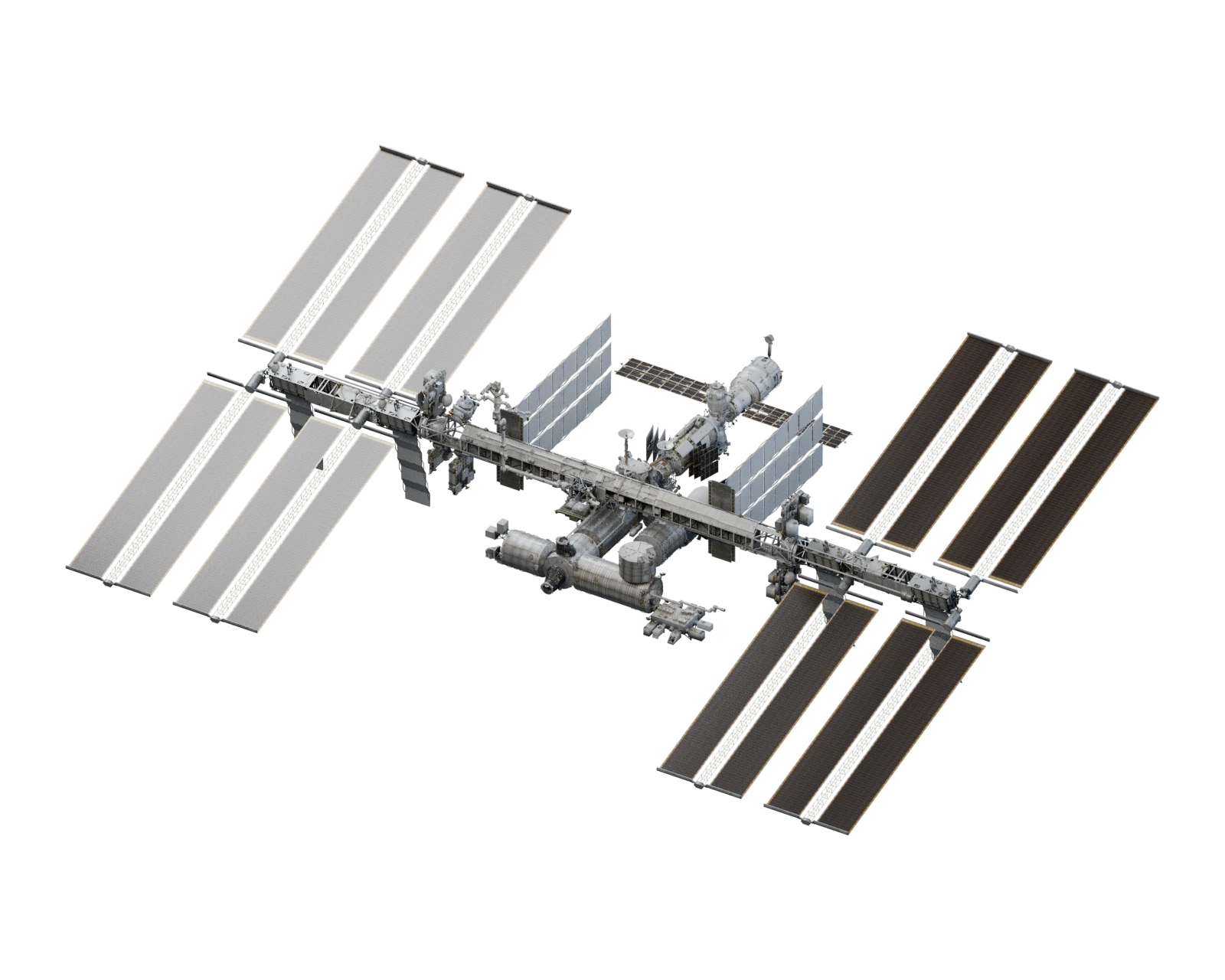
The International Space Station is a laboratory built from many modules, with a long truss carrying its solar arrays and radiators. Assembly began in 1998, and people have lived aboard continuously since November 2000. Its orbit changes as atmospheric drag lowers it and visiting spacecraft boost it again.
The ISS flies about 400 km up on an orbit tilted 51.6° to the equator, so it passes over everywhere between 51.6° north and south, which is where nine in ten people live. One lap takes about 93 minutes, and the crew sees roughly sixteen sunrises a day. From the ground it looks like a very bright star that does not blink, crossing the sky in a few minutes just after dusk or before dawn.
ISS timeline
| When | Event |
|---|---|
| 20 Nov 1998 | Zarya launches |
| Dec 1998 | Unity joins Zarya |
| 2 Nov 2000 | Continuous occupation begins |
| Mar 2009 | Main truss assembly complete |
| 2021 | New roll-out solar arrays begin |
Can you see the ISS without a telescope?
Yes. When it passes overhead it is the third-brightest thing in the sky after the Sun and the Moon: a steady white light moving faster than a plane.
How many people are on the ISS?
Usually seven, and more for a few days when one crew hands over to the next.
How long will the ISS keep flying?
NASA plans to operate it through 2030 and then steer it into the Pacific Ocean with a purpose-built deorbit vehicle.
Hubble
A space telescope observing above Earth’s atmosphere. Launched 24 April 1990.
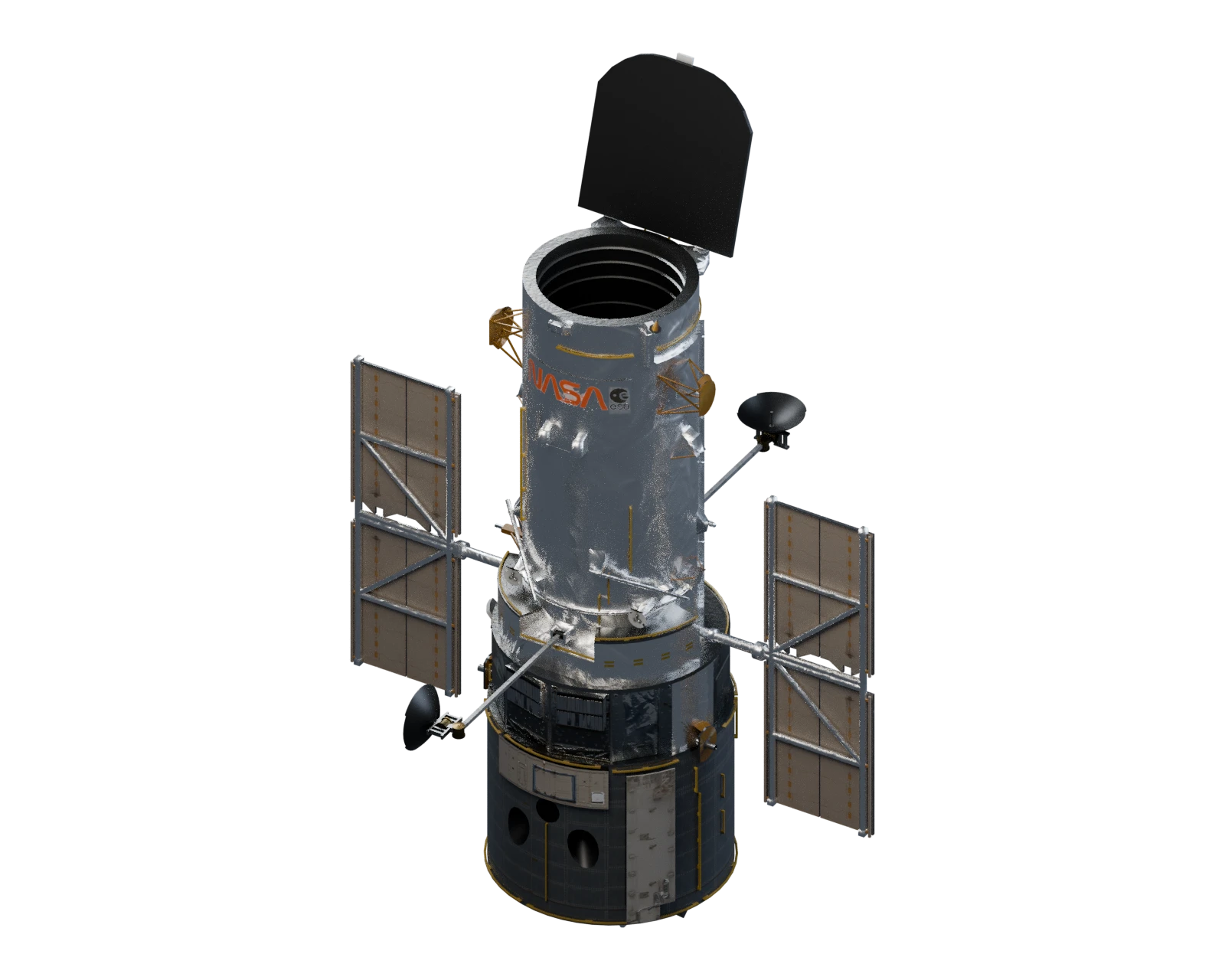
Hubble observes ultraviolet, visible and near-infrared light with a 2.4-metre primary mirror. The space shuttle Discovery launched it in April 1990. Five servicing missions repaired and upgraded the observatory; the final visit was in 2009. Unlike Webb, Hubble circles Earth in low orbit.
Hubble flies roughly 500 km up, higher than either space station, on an orbit tilted 28.5° to the equator: the tilt it got from a launch due east out of Florida. One lap takes about 95 minutes. Nothing has boosted it since the last shuttle visit in 2009, and the thin air at that height lowers it a little every year. It can be seen with the naked eye, best from between 28.5° north and south, the band it flies over.
Hubble timeline
| When | Event |
|---|---|
| 24 Apr 1990 | Launch on Discovery |
| Dec 1993 | First servicing mission |
| Mar 2002 | Advanced Camera installed |
| May 2009 | Final servicing mission |
Is Hubble still working?
Yes. Since 2024 it has pointed with one gyroscope instead of three, which costs it some observing time, and it is still returning science images.
How long will Hubble stay in orbit?
Without a boost, drag is expected to bring it down in the 2030s. NASA has studied raising its orbit, but no mission is planned.
Tiangong
China’s three-module laboratory in Earth orbit. First module launched 29 April 2021.
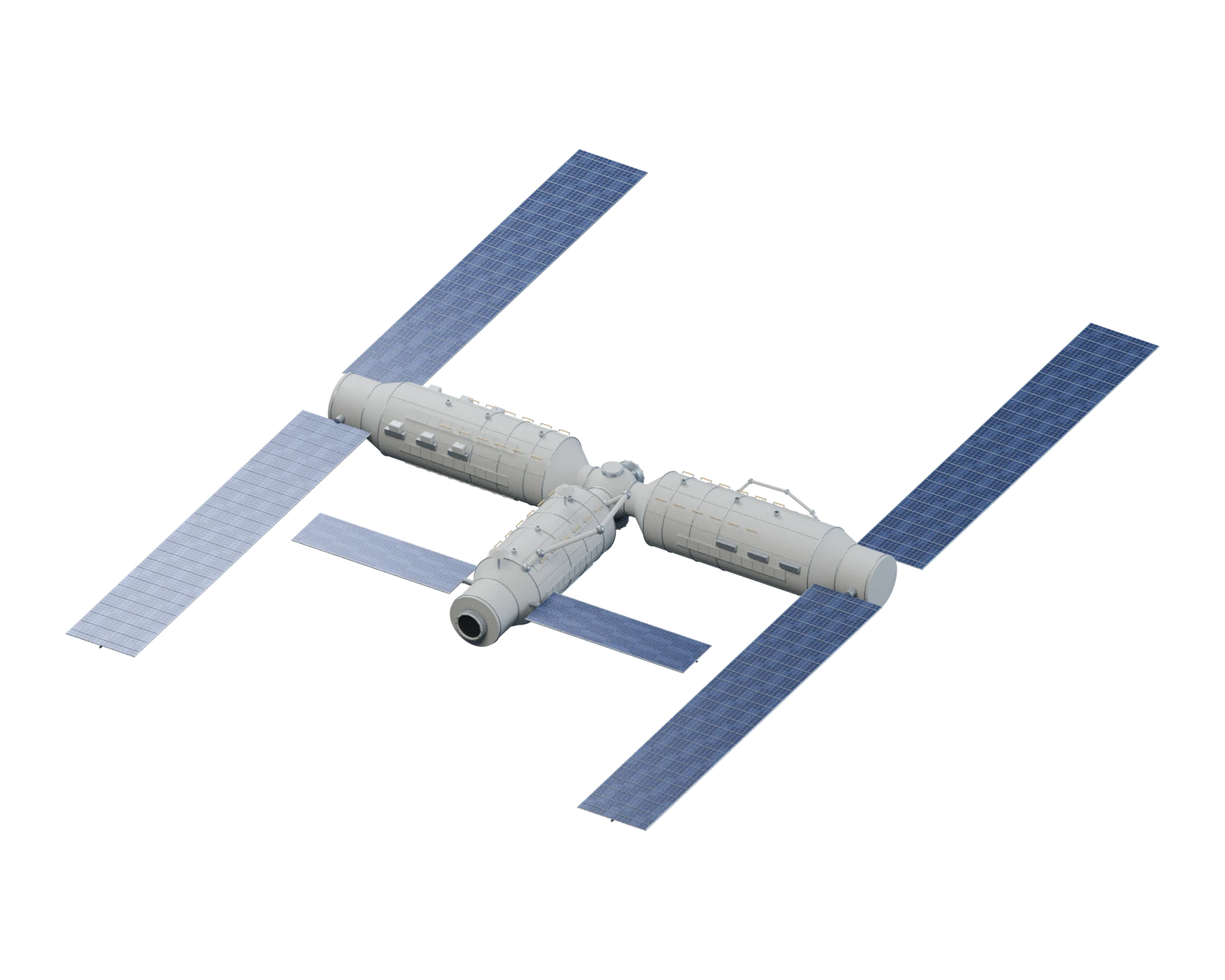
Tiangong is China’s crewed space station. Its Tianhe core module launched in April 2021; the Wentian and Mengtian laboratories joined in 2022 to form a T-shaped station. Shenzhou spacecraft carry crews, and Tianzhou vehicles deliver supplies. It is a separate station from the ISS.
Tiangong flies about 390 km up on an orbit tilted 41.5° to the equator, so it stays between 41.5° north and south. That takes it over every Chinese launch site and most of the world's people, but never as far north as Britain or Germany. One lap takes about 92 minutes. Like the ISS it sinks slowly through thin air and fires its engines to climb back.
Tiangong timeline
| When | Event |
|---|---|
| 29 Apr 2021 | Tianhe core launches |
| Jun 2021 | First crew arrives |
| Jul 2022 | Wentian laboratory joins |
| Oct 2022 | Mengtian laboratory launches |
| Nov 2022 | Three-module T configuration |
How many astronauts live on Tiangong?
Three, for about six months at a time. For a few days at each handover there are six aboard.
How big is Tiangong compared with the ISS?
Much smaller: three modules and about 69 tonnes, roughly a sixth of the mass of the ISS.
Can you see Tiangong from the ground?
Yes, with the naked eye. It looks like a bright star moving steadily across the sky around dusk or dawn, from anywhere between about 45° north and south.
▶ Watch Tiangong orbit · Mission facts from China Manned Space →
What the simulator does
- Open the Now tab: the clock jumps to this minute and pauses, and every probe is drawn where JPL Horizons puts it, among the planets where they really are.
- Pick a spacecraft and the view centres on it. The ISS, Hubble and Tiangong open Earth up close, each moving on its real orbit.
Questions people ask
Which spacecraft is farthest from Earth?
Voyager 1, at 25.9 billion km (16.1 billion mi), or 173.2 AU. A radio signal takes 24.0 hours each way. Voyager 2 is next at 21.7 billion km.
Which spacecraft is moving fastest right now?
Of the ones on this page, Parker Solar Probe: 53.0 km/s (190,980 km/h, 118,669 mph) relative to the Sun today. It also holds the record: about 692,000 km/h at its closest to the Sun.
How fresh are the numbers?
The probes' positions come from JPL Horizons, NASA's ephemeris service, in tables this site refreshes daily; the page works out this minute's position from them. The ISS, Hubble and Tiangong are worked out from CelesTrak orbital elements: estimates, not live telemetry, with the date of the elements shown beside them.
Keep going
Probe distances: JPL Horizons. Earth orbiters: CelesTrak elements, through the same orbit model the simulator uses. The map and the simulator place the planets with the site's own physics.